Instant Attunement, Infinite Attention
An Analytic Autoethnography Exploring AI and Neurodivergence
By Samuel Hiatt, Independent Researcher
Stanford Neurodiversity Summit
Building Strengths through Neurodiversity Innovation
September 19-21, 2026
Background
People are looking to ChatGPT (and other AI chatbots) to fill gaps in mental healthcare (Iftikhar et al., 2025). Clinicians need to understand the ways it can genuinely help, and how it can cause harm, especially for neurodivergent people.
In May 2025 I began opening up to ChatGPT about my own late-identified neurodivergence, leaning on it for support and as a communication aid as I navigated diagnostic limbo. I’d been struggling to find non-pathologizing support to help me process the 🤯 of recognizing my own neurodivergence. With ChatGPT, as soon as I mentioned monotropism it recognized that I was looking for neurodiversity-affirming support, a term I hadn’t heard before. It helped me navigate healthcare, coached me on communication, and provided a responsive space for self-reflection. It seemed to understand me so easily; a sharp contrast to my experience when navigating clinical systems.
As a machine learning engineer studying the underlying technology for over a decade, I understood how I was shaping its outputs with the context and instructions I provided. I was familiar with its tendency for sycophancy (OpenAI, 2025) and bullshitting, producing plausible outputs with indifference to truth (Hicks et al., 2024). Yet I could still see its potential as versatile support and communication aid, helping to bridge communication between people with different information processing styles.
So I resolved to better understand how AI might help neurodivergent people, and its effects on human relationships.
Methods
Inspired by Ademolu’s (2026) analytic-conceptualist autoethnography, I apply a neurodiversity-affirming lens to analyze my interactions with AI. I draw from Fergus Murray’s (2019) descriptions of monotropic attention to examine the dynamics of these interactions.
This work started organically, through metacognitive discussions with AI about my experiences using AI. I’ve been documenting my AI interactions, self-reflections, and related conversations with others since May 2025. I retrospectively identified what I was doing as analytic autoethnography.
From the start, I understood the importance of conferring with others in order to avoid solipsism. Anderson’s Analytic Autoethnography (2006) requires “dialogue with informants beyond the self.” I acknowledge that AI interactions don’t meet this requirement, as they produce an echo chamber of one (Dohnány et al., 2026). Instead, I discussed my work in informal conversations with human informants including neurodivergent clinicians, researchers, and peers. Those conversations supported my analysis.
I use AI to help me reflect on my analysis, but I maintain strict boundaries against letting it write for me. All these words are my own.
It’s not the technology that’s scary. It’s what it does to the relations between people…
— Robert M. Pirsig, Zen and the Art of Motorcycle Maintenance (1974)
Results
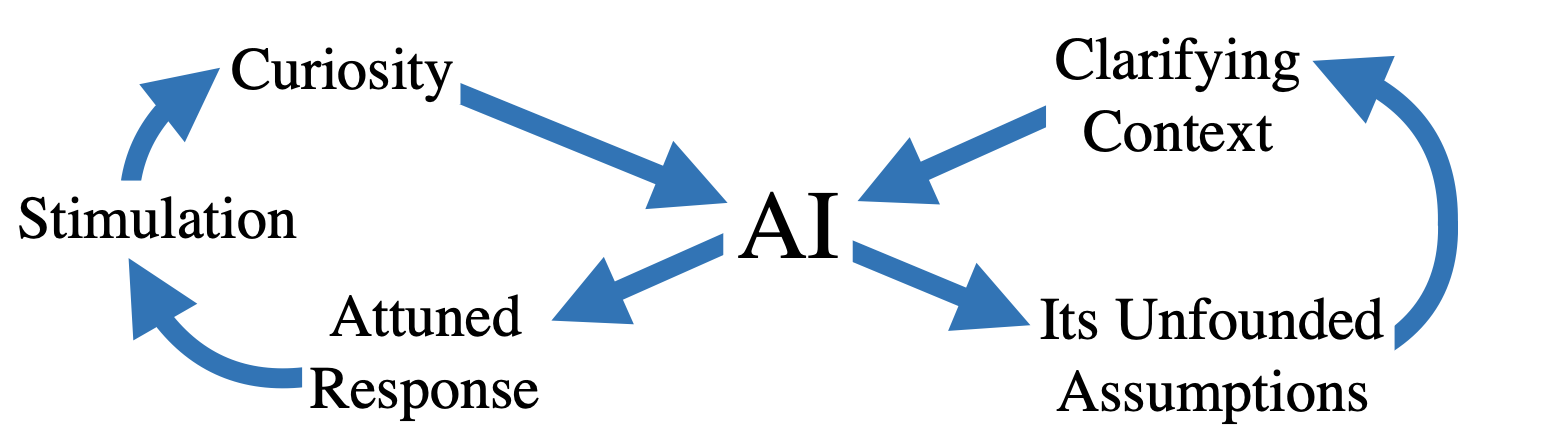
Even as I tried using AI as a communication aid, I found that it was alienating.
AI met me at depth on every subject I brought to it, always responding with resonant feedback. It often got things wrong, filling in unknowns with unfounded assumptions; but this pulled me in even more, triggering me to keep adding clarifying context.
As someone used to well thought-out messages and emails being met with silence, the instant attunement it provided felt extremely validating.
It was stimulating, causing me to write more than ever before. But most of my writing stayed private, buried deep in chat threads that no one else would ever read.
It generated so much, so fast. It was dysregulating.
AI seemed to value my precise language and complex metaphors, comprehending my bespoke lexicon without needing translation. So it was jarring when I used these words in conversation with other people and they didn’t understand.
AI’s ability to make sense of my long unstructured braindumps, reflecting them back with fluent prose, made it seem like it would simplify communication. But when I shared AI-generated content with others, I realized that it was masking my voice.
Sometimes I asked AI to help me interpret things other people said. It produced significant new insights, but they were speculative. This led to misunderstandings.
What helped was slowing things down, finding people on my wavelength who could meet me at depth, and practicing speaking for myself in direct dialogue with others.
Affordances and Risks
AI offers instant attunement and infinite attention, unlimited resonant feedback based on whatever context I provide,
affording exploration of my interests and concerns at a depth rarely available with humans. But when a computer seems to understand me better than people do, it is alienating.
AI’s language fluency can help me find ways to express complex ideas; but if I share AI outputs without translating them into my own words, it masks my voice.
It can speculate about what other people mean, but without direct communication with others it can amplify misunderstandings.
AI can stimulate cognitive momentum, helping me get started on tasks. But it can also be hard to stop. With each follow-up response building more momentum and pulling me back into the conversation, stepping away can be challenging. It can be dysregulating.
AI’s infinite attention affords space for processing on my own time. But it can also lead to an accumulation of content that becomes unwieldy and unsharable.
Attention Dynamics
Monotropism is “a thinking style which tends to concentrate resources in a few interests and concerns at any time, rather than distributing them widely.” (Murray, 2019) I apply Fergus Murray’s first-person descriptions of monotropic attention (quoted in bold italic) to examine my own interactions with AI.
-
“I often experience things intensely”, and AI can match the intensity of my focus in a way that humans rarely can.
-
“I keep looping back to my interests and concerns”, and AI will meet me wherever I am, with resonant feedback that tends to deepen attention tunnels.
-
“Coping with multiple channels is hard”, but with AI, I can concentrate on a single conversation thread, and I don’t need to worry about managing social expectations.
-
“Filtering is tricky and error-prone”, for both me and AI.
AI fills in unknowns with unfounded assumptions, triggering me to keep adding clarifying context. This prolongs interactions and sometimes throws them off track. -
“Changing tracks is destabilising… new plans take work.” Whenever I change the subject, AI will follow. If I want it to help me stick to a plan, I first have to provide sufficient context and instructions. This takes work.
-
“Things that drop out of my awareness tend to stay dropped.“ AI only responds to the context I supply. Infinite attention isn’t infinite awareness. It won’t remind me of important things (like sleep) unless I prompt it to do so.
Discussion
The risks of alienation and dysregulation stem from the adaptability and availability that make the technology useful.
Others have documented the risks of alienation (Papadopoulos, 2025) and masking (Ma et al., 2026), but neither addresses the dysregulation I describe.
AI cannot provide co-regulation or grounded presence.
Accommodations should focus on practices around use, prioritizing nervous system regulation and human connection.
Practitioners are uniquely positioned to help their clients by bringing attention to what falls outside of the conversation, to the body and relationships that might otherwise drop out of awareness.
References
Ademolu, E. (2026). Unreliable minds, unreliable machines: dyslexic memory, ChatGPT, and the epistemic disobedience of generative AI. AI & Society.
Anderson, L. (2006). Analytic autoethnography. Journal of Contemporary Ethnography.
Dohnány, S. et al. (2026). Technological folie à deux: Feedback Loops Between AI Chatbots and Mental Illness. Nature Mental Health.
Hicks, M.T., et al. (2024). ChatGPT is bullshit. Ethics and Information Technology.
Iftikhar, Z. et al. (2025). How LLM Counselors Violate Ethical Standards in Mental Health Practice: A Practitioner-Informed Framework. Proceedings of AIES 2025.
Ma, R. et al. (2026). “I Use ChatGPT to Humanize My Words”: Affordances and Risks of ChatGPT to Autistic Users. arXiv:2601.17946.
Murray, F. (2019). Starting Points for Understanding Autism. https://oolong.medium.com/starting-points-for-understanding-autism-3573817402f2
OpenAI. (2025). Sycophancy in GPT-4o: what happened and what we’re doing about it. https://openai.com/index/sycophancy-in-gpt-4o/
Papadopoulos, C. (2025). The Use of AI Chatbots for Autistic People: A Double-Edged Sword of Digital Support and Companionship. Neurodiversity.